Author: Bobadilla, Rachel

Marc Reyes Successfully Defends Dissertation; Accepts Stanford Fellowship

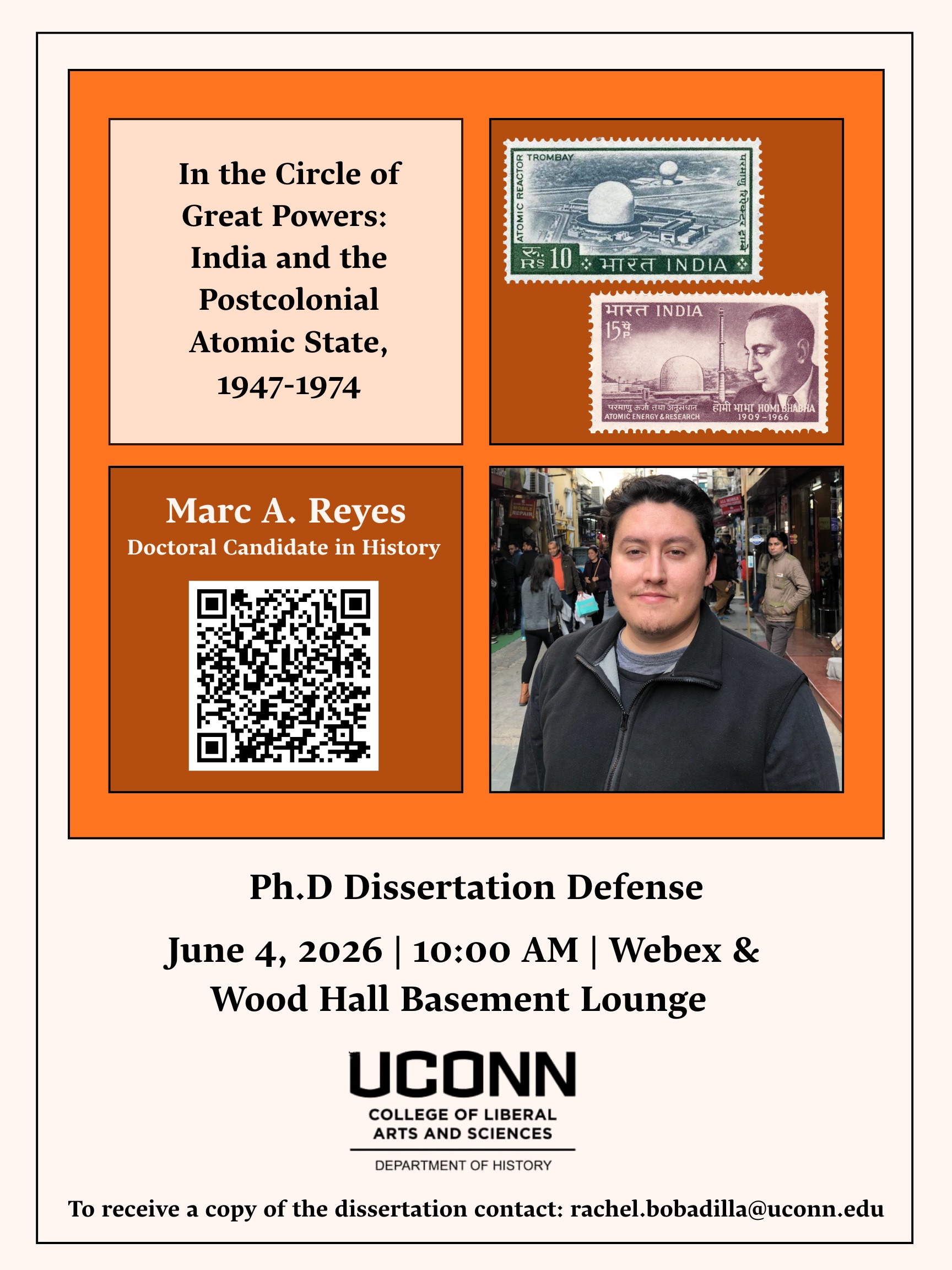
On June 4th, Marc Reyes successfully defended his dissertation, “In the Circle of Great Powers: India and the Postcolonial Atomic State, 1947-1974.” Next, he will begin a postdoctoral fellowship at Stanford University’s Center for International Security and Cooperation (CISAC). During his appointment, Marc will present his research at CISAC weekly seminars, revise his dissertation chapters into journal articles, and participate in the fellows’ policy workshops and simulations.

From Marc’s dissertation abstract:

This dissertation examines the diplomatic, political, and intellectual history of India’s atomic energy program, using its research of the atom as a lens to better understand the country’s thinking and actions during the Cold War and beyond. It sheds light on how Indians, from public officials to security strategists to academics, preached the necessity of atomic energy’s peaceful uses while also issuing ambiguous statements regarding the development of nuclear weapons. Incorporating sources from multiple countries and over a dozen archives and libraries, the project views India’s atomic energy program as a transnational project shaped by Indian and non-Indian actors. The study concludes that India’s pursuit of the bomb went beyond scientific prestige and recognition as a modern state. After India’s decisive victory over Pakistan in a 1971 war, Indian leaders, such as prime minister Indira Gandhi, embraced the concept of an Indian bomb. Upon its 1974 “peaceful nuclear explosion,” Gandhi believed her country now had the mettle to stand in line with the world’s great powers.

Congratulations Dr. MaMarc Reyes defense poster for June 4 2026rc Reyes on these impressive achievements!
“The Second American Revolution” exhibit curated by Manisha Sinha to open at Abraham Lincoln Presidential Library and Museum on June 5th

Professor Sinha will give a talk on the exhibit and her work as a Reconstruction Historian on June 4th at a special preview of “The Second American Revolution”. The exhibit will be open from June 5 through January 17 and explores the Reconstruction era’s early efforts to give newly freed and free Black Americans full citizenship and rights, and the ways in which this mission was largely eroded leaving America with consequences that have followed the nation into the 21st century. 

You can read more about this exhibit on the Abraham Lincoln Presidential Library and Museum website here:

New exhibit on Civil War’s aftermath coming to ALPLM

Liberation Summer by Professor Micki McElya Published to Rave Reviews

Professor McElya’s 2026 book Liberation Suliberation summer by Micki McElya cover showing women holding up a large caricature figure of a pageant contestantmmer, about a key moment in the women’s liberation movement surrounding the 1968 Miss America pageant and the reactions and protests it was surrounded by, has been widely recommended by the New York Times, the Boston Globe and Kirk’s reviews. Her last book about the history of Arlington National Cemetery was a finalist for the Pulitzer.

The Nonfiction Everyone Will Be Reading This Summer – The New York Times

75 favorite books and best summer reads to check out this season

Micki McElya | Kirkus Reviews


Manisha Sinha Cited in Article “Fugitive Sanctuaries” on Key Forces in Migrant Movement and Freedom

The article, written by Ananya Roy for Jewish Currents, contextualizes the current immigration “enforcement” crisis among historical moments that shaped laws now serving as the backdrop for the criminalization of racialized migrant communities. One of the key moments which demonstrates the article’s emphasis on communities creating their own networks and momentum towards freedom rather than states or cities fostering and protecting this freedom as its own mission, is of course that of the Abolition Movement and the Underground Railroad. Sinha’s article “The Abolitionist Underground” is cited amongst other scholarly work evidencing how governments respond to freedom movements rather than being the agents enabling and protecting residents as many are taught to understand historical narratives around individual freedoms being codified.

Read Fugitive Sanctuaries by Ananya Roy

Read The Abolitionist Underground by Manisha Sinha

Bad Bunny and UConn History Graduate Program Alum Jorell Meléndez-Badillo’s Collaboration Brings Puerto Rican History to Listeners Around the World

Jorell Meléndez-Badillo’s book, “Puerto Rico: A National History”, brought together the historian of Puerto Rican history and one of the island’s biggest stars to produce visualizer and music video text that would educate fans and spotlight crucial context for the 2025 DeBÍ TiRAR MáS FOToS album’s songs.

Bad Bunny contacted professor Jorell Meléndez-Badillo who now works at UW Madison when planning the album’s online music video releases. The album won Album of the Year, and some of the songs were performed at the Super Bowl LX halftime show featuring Bad Bunny bringing history to football fans and avid listeners alike for the most watched halftime show ever.

You can read an article by Professor Meléndez-Badillo on working with Bad Bunny here:

Essay: Bad Bunny’s Super Bowl halftime show will be a history lesson for the ages – Los Angeles Times

And read a UW-Madison article about the collaboration here:

Pop star Bad Bunny needed a Puerto Rican history scholar. UW–Madison had just the one. – UW–Madison News

Professor Brendan Kane on teaching, learning and researching Early Modern Gaelic in a digital age

On November 5, 2025, Professor Brendan Kane presented a research seminar titled “Teaching, learning and researching Early Modern Gaelic in a digital age: Léamh.org and the practice of collaborative digital humanities.” The event was hosted at Sabhal Mòr Ostaig, a college in the west of Scotland. The talk discussed ongoing efforts to teach people Early Modern Irish and Classical Gaelic, using the innovative Léamh.org, a web tool that uses games and other methods to assist users in learning grammar and reading digitized manuscripts. 

You can watch a recording of the talk here

Professor Deirdre Cooper-Owens and others collaborate to ensure that the grim roots of modern gynecology are not erased

As the Smithsonian and other museums face challenges from the Trump administration about the content of exhibits that examine racial history in US history, Professor Deirdre Cooper-Owens is collaborating on educational efforts with activist and artist Michelle Browder to remember and honor the victims of medical abuse at the hands of James Marion Sims and other doctors since. Sims is broadly called the “father of modern gynecology”, but his victims- enslaved black women who historians had to work to recover the identities of, are now known only thanks to artists like Browder and dedicated research efforts by historians.

Dr. Cooper-Owens work on this front includes the 2017 book Medical Bondage, which delves into the long history of extensive exploitation and harm of black people and bodies in efforts to further medicine in US history. Browder’s artwork challenges the common narrative of a medical legacy built on unwilling procedures on enslaved women carried out by Sims through the construction and placement of pieces like “The Mothers of Gynecology” which represents Anarcha Westcott, Betsey, and Lucy, who Sims experimented on. The article emphasizes the importance of preserving and sharing these histories, and provides links to further reading about more incidents of experimentation and theft of bodily autonomy as well, noting infamous cases such as the Tuskegee Syphilis Study, and the story of Henrietta Lacks.

Full article here:

The Trump Administration Wants To Whitewash History. These Black Historians and Activists are Memorializing the Sins of an Infamous Gynecologist