Web cookies (also called HTTP cookies, browser cookies, or simply cookies) are small pieces of data that websites store on your device (computer, phone, etc.) through your web browser. They are used to remember information about you and your interactions with the site.
Purpose of Cookies:
Session Management:
Keeping you logged in
Remembering items in a shopping cart
Saving language or theme preferences
Personalization:
Tailoring content or ads based on your previous activity
Tracking & Analytics:
Monitoring browsing behavior for analytics or marketing purposes
Types of Cookies:
Session Cookies:
Temporary; deleted when you close your browser
Used for things like keeping you logged in during a single session
Persistent Cookies:
Stored on your device until they expire or are manually deleted
Used for remembering login credentials, settings, etc.
First-Party Cookies:
Set by the website you're visiting directly
Third-Party Cookies:
Set by other domains (usually advertisers) embedded in the website
Commonly used for tracking across multiple sites
Authentication cookies are a special type of web cookie used to identify and verify a user after they log in to a website or web application.
What They Do:
Once you log in to a site, the server creates an authentication cookie and sends it to your browser. This cookie:
Proves to the website that you're logged in
Prevents you from having to log in again on every page you visit
Can persist across sessions if you select "Remember me"
What's Inside an Authentication Cookie?
Typically, it contains:
A unique session ID (not your actual password)
Optional metadata (e.g., expiration time, security flags)
Analytics cookies are cookies used to collect data about how visitors interact with a website. Their primary purpose is to help website owners understand and improve user experience by analyzing things like:
How users navigate the site
Which pages are most/least visited
How long users stay on each page
What device, browser, or location the user is from
What They Track:
Some examples of data analytics cookies may collect:
Page views and time spent on pages
Click paths (how users move from page to page)
Bounce rate (users who leave without interacting)
User demographics (location, language, device)
Referring websites (how users arrived at the site)
Here’s how you can disable cookies in common browsers:
1. Google Chrome
Open Chrome and click the three vertical dots in the top-right corner.
Go to Settings > Privacy and security > Cookies and other site data.
Choose your preferred option:
Block all cookies (not recommended, can break most websites).
Block third-party cookies (can block ads and tracking cookies).
2. Mozilla Firefox
Open Firefox and click the three horizontal lines in the top-right corner.
Go to Settings > Privacy & Security.
Under the Enhanced Tracking Protection section, choose Strict to block most cookies or Custom to manually choose which cookies to block.
3. Safari
Open Safari and click Safari in the top-left corner of the screen.
Go to Preferences > Privacy.
Check Block all cookies to stop all cookies, or select options to block third-party cookies.
4. Microsoft Edge
Open Edge and click the three horizontal dots in the top-right corner.
Go to Settings > Privacy, search, and services > Cookies and site permissions.
Select your cookie settings from there, including blocking all cookies or blocking third-party cookies.
5. On Mobile (iOS/Android)
For Safari on iOS: Go to Settings > Safari > Privacy & Security > Block All Cookies.
For Chrome on Android: Open the app, tap the three dots, go to Settings > Privacy and security > Cookies.
Be Aware:
Disabling cookies can make your online experience more difficult. Some websites may not load properly, or you may be logged out frequently. Also, certain features may not work as expected.
The Academic Leadership Award honors exemplary leadership by an individual who oversees a CLAS department, school, center, institute, or program. At this year’s CLAS Faculty and Staff Awards, Department Head Mark Healey was recognized for his leadership in strengthening departmental climate, transparency, and academic success.
The prize was awarded at the Organization of American Historians meeting in Philadelphia on April 17, 2026. The prize citation reads:
Following a multi-tiered selection process, the committee selected The Rise and Fall of the Second American Republic: Reconstruction, 1860–1920 by Manisha Sinha as the recipient of the SHGAPE President’s Book Prize.
Manisha Sinha’s The Rise and Fall of the Second American Republic offers a sweeping and compelling reinterpretation of Reconstruction, significantly expanding both the temporal and geographic boundaries traditionally associated with the period. Sinha provides a major new synthesis of Reconstruction scholarship—one that will stand alongside the seminal works of Eric Foner and W. E. B. Du Bois as a benchmark for a new generation of historians. The book will serve as a central text in graduate seminars on nineteenth-century U.S. history for years to come. Grounded in extensive archival research but driven by a clear and persuasive argument about the broader scope and significance of Reconstruction, it will shape how historians and their students understand this critical era. It is a powerful and important work and fully deserving of the SHGAPE President’s Book Prize.
Participants in the four-hour retreat received a certificate upon completion of the event (contributed photo; UConn Today).
Edina Oestreicher, the executive director of UConn Hillel, said that she was invited to apply for a grant to create a “Campus Connections” initiative where student leaders gain the transferable skills of actively listening, asking meaningful questions, and practicing thoughtful communication with other leaders. With the grant, UConn Hillel partnered with the Gladstein Family Human Rights Institute to host an interactive workshop facilitated by faculty affiliated with the “Democracy and Dialogues Initiative.”
History Professor Brendan Kane, co-director of the “Democracy & Dialogues” program, started thinking about creating a new dialogue model for respectful communication back in 2016. Kane wanted to engage scholars in meaningful and dynamic ways with community members, emphasizing UConn’s mission as a public university. Simultaneously, witnessing universities trying to implement spaces for dialogue after widespread incidents of racism occurred across campuses nationwide, Kane wanted to create a unique process to build strong and resilient communities. The “Democracy and Dialogues Initiative” is part of Dodd Human Rights Impact Programs.
Professor Andy Horowitz, author of the prize-winning book Katrina: A History, 1915–2015, has been consulted widely around Katrina’s 20th anniversary. Listen to him on NPR Morning Edition, and read his essay “Katrina’s America” in a special issue of the journal Southern Cultures that he guest edited.
Luke Reynolds has been invited to deliver the annual Siborne Lecture at the National Army Museum in London on June 19th. This lecture is part of the National Army Museum’s Waterloo Week (16 – 22 June) held to mark the 210th anniversary of the Battle of Waterloo.
In collaboration with Connecticut Humanities and the Connecticut Museum of Culture and History, Fiona Vernal has made an online platform TheirStory accessible to CT organizations and residents to support the creation of oral history collections. Vernal began working with TheirStory creator Zack Ellis in 2022 working on a project on West Indian, African American, and Puerto Rican migrations to Hartford. The article also details the other CT organization and communities that have benefitted from this collaboration.
Professor Helen Rozwadowski was interviewed for the Blue History Network Podcast, which is now up on Spotify and the network’s website. In this podcast, Professor Rozwadowski delves into “a wide variety of subjects, from oceanography in the Nineteenth century to how we, in the present, bring ocean history to the attention of the public“. She also discusses her books, Fathoming the Ocean and Vast Expanses.
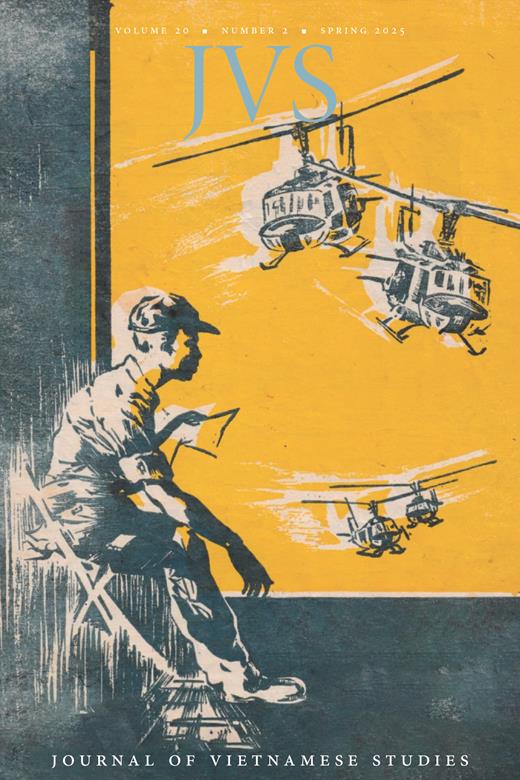
On the 50th anniversary of the Vietnam War, a special issue of the Journal of Vietnamese Studies offers thirteen original translations of Vietnamese songs, poems, memoirs, and fiction about the end of the war and its aftermath. Co-edited by Nu-Anh Tran and Trinh M. Luu, the collection is ideal for teaching at the college- and high school-level. Browse the issue at https://online.ucpress.edu/jvs/issue/20/2
Earlier this month, Professor Alexis Dudden was quoted in the New York Times article, “How South Korea’s Democracy Prevailed Over a Reckless Leader”. The article, written by Choe Sang-Hun, analyzes the attempted coup by former South Korean president Yoon Suk Yeol and what its outcome says about democracy in South Korea.
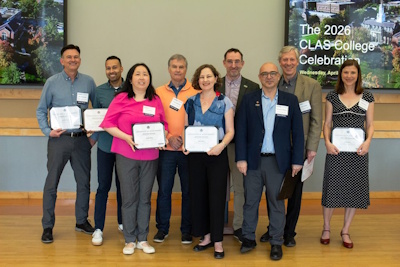 The Academic Leadership Award honors exemplary leadership by an individual who oversees a CLAS department, school, center, institute, or program. At this year’s CLAS Faculty and Staff Awards, Department Head Mark Healey was recognized for his leadership in strengthening departmental climate, transparency, and academic success.