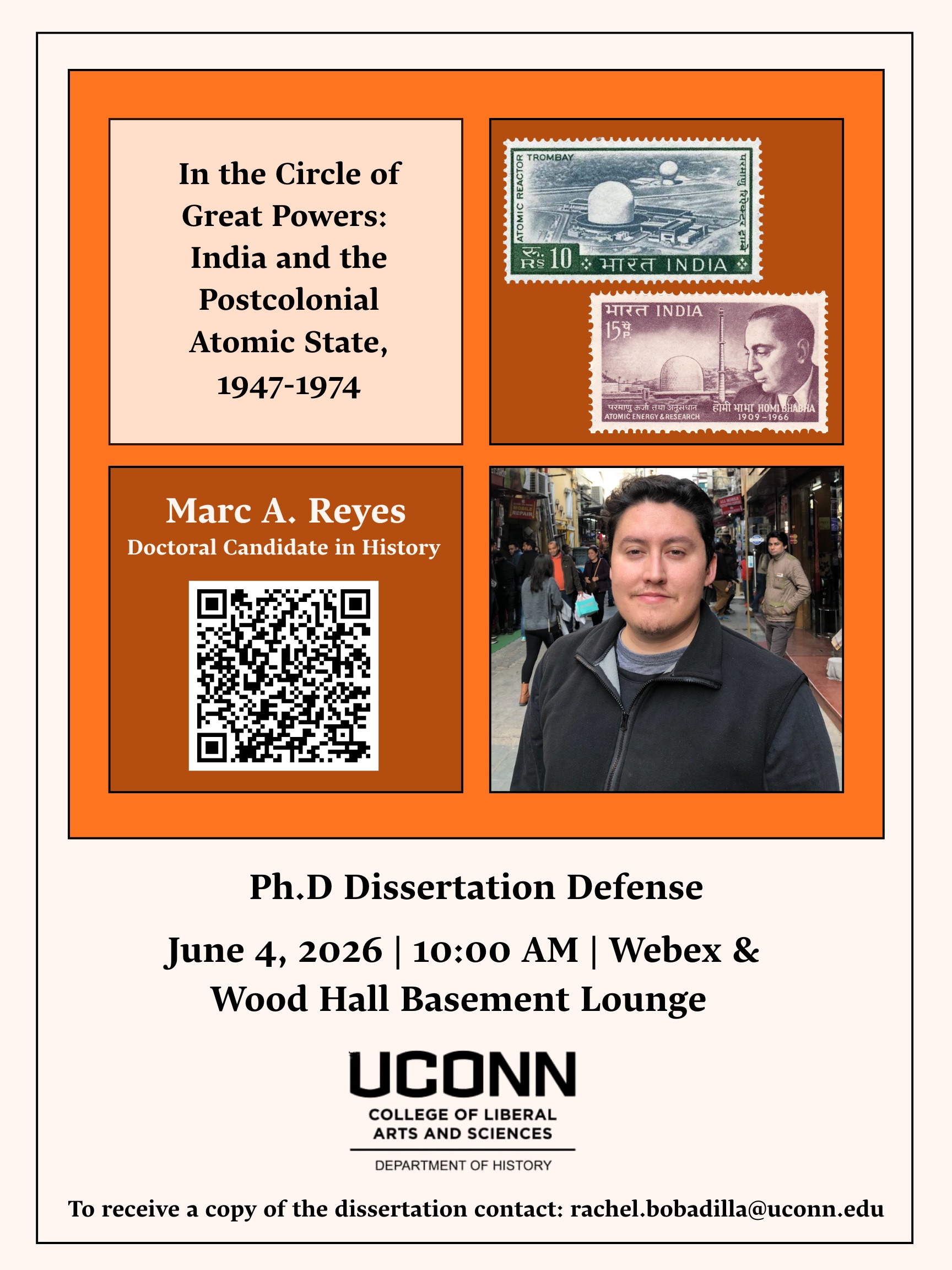
On June 4th, Marc Reyes successfully defended his dissertation, “In the Circle of Great Powers: India and the Postcolonial Atomic State, 1947-1974.” Next, he will begin a postdoctoral fellowship at Stanford University’s Center for International Security and Cooperation (CISAC). During his appointment, Marc will present his research at CISAC weekly seminars, revise his dissertation chapters into journal articles, and participate in the fellows’ policy workshops and simulations.
From Marc’s dissertation abstract:
This dissertation examines the diplomatic, political, and intellectual history of India’s atomic energy program, using its research of the atom as a lens to better understand the country’s thinking and actions during the Cold War and beyond. It sheds light on how Indians, from public officials to security strategists to academics, preached the necessity of atomic energy’s peaceful uses while also issuing ambiguous statements regarding the development of nuclear weapons. Incorporating sources from multiple countries and over a dozen archives and libraries, the project views India’s atomic energy program as a transnational project shaped by Indian and non-Indian actors. The study concludes that India’s pursuit of the bomb went beyond scientific prestige and recognition as a modern state. After India’s decisive victory over Pakistan in a 1971 war, Indian leaders, such as prime minister Indira Gandhi, embraced the concept of an Indian bomb. Upon its 1974 “peaceful nuclear explosion,” Gandhi believed her country now had the mettle to stand in line with the world’s great powers.
Congratulations Dr. Ma rc Reyes on these impressive achievements!