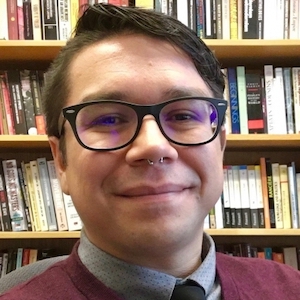
In November 2021, UConn History Master’s student Matthew Novosad presented at UConn’s annual Graduate Research Conference. This conference is an opportunity for 2nd year graduate students to engage their research ideas with the broader UConn community. The work presented at this conference is based on research conducted during the 5102 course, “Historical Research and Writing.” Matthew Novosad’s research examines perceptions of submarine warfare during the First World War. His paper was titled, ” ‘The law of nations, the law of man, and the law of God’: Discourse on Submarine Warfare in American Newspapers during the First World War.” He is also the president of the Franklin Historical Society and board member of Ashbel Woodward Museum in Franklin, CT.
1) What is your 5102 research project about? What are the central research questions? What are some of your findings?
My 5102 Research project was about the discourses about submarine warfare during the First World War in the United States. I primarily utilized newspapers for this project, drawing especially on editorials, advertisements, and letters to the editor. One of the guiding questions for all of my research, not just this project, is why did the submarine come to be almost exclusively associated with Germany during the World Wars, even when other countries made extensive usage of their submarine fleets? As well, I am also interested in how was the submarine understood during the war. I felt that one potential way to explore these questions was to look at how submarines were being discussed in the United States and to thus see if the discourse was about the submarine as an object. As I discovered, the conversations were mostly about the usage of submarines and how people viewed that usage within a legal framework. Additionally, I was interested in how the submarine was viewed in a wider cultural context but was only able to scratch the surface of that theme with this project. Films, I feel, would be an interesting angle to explore as there were multiple submarine related movies produced and released during the war that didn’t have much utilize the conflict as a theme – such as The Submarine Pirate in 1915 which starred Charlie Chaplin’s half-brother Sydney Chaplin. Another was the 1916 production of 20,000 Leagues Under the Sea.
2) How did you become interested in your research topic?
My father was a submariner during the late Cold War and he served onboard the USS George Washington Carver (SSBN 656) and the USS Augusta (SSN 710) so I grew up in a Navy household covered in Navy and submarine decorations. I also attended the Avery Point campus for my BA and most days I drove by a sign which stated that Groton is the “Submarine Capital of the World”. We could look out of our classroom windows and maybe see a Submarine leaving the Thames River and Long Island Sound for the Atlantic. I’d say I’m a product of my environment.
Additionally, I’ve always had an interest in the First World War and when I was an undergraduate, I discovered pictures of British and French submarines which had participated in the Gallipoli campaign in 1915. I had never known, up until that point, that the Allied powers utilized submarines during the First World War. It sent me on an odyssey to discover as much as I can about them. There are many questions I feel that can be explored through the Allied usage of submarines: What challenges does a naval war pose to coalition warfare? How did the Allied powers fit the usage of submarines into their strategies? How did they ‘sell’ their usage when they were condemning the Germans for Unrestricted Submarine Warfare? What relationship existed between civilians and an, at the time, relatively new weapons system? What can we glean about an emerging military-industrial complex (or as other scholars have termed for this period a “naval-industrial complex”)? How were the experiences of the First World War absorbed institutionally by Allied navies, how did that affect them going into the Second World War?
That’s a bit of a long-winded way of saying I became interested in this particular topic for my 5102 Paper in an effort to hopefully learn a little bit about the disconnect between the Allied usage of submarines during the war, and why they are almost non-existent in many accounts of the war at sea during the First World War. The specific shape that the project took, analyzing material that mostly came from newspapers, was the result of circumstance. COVID-19 and attending my first year of Graduate School online made doing other sorts of research more problematic.
3) What were some of the strategies that you used to organize your research? Did you use any digital tools or software?
My main organizational tool was Zotero. It made not only saving and organizing the secondary literature easy, it also let me maintain a well-organized database of my primary sources. I sorted them principally by date as I was exploring responses to the submarine at certain “flashpoints” such as the sinking of the Lusitania in 1915 or the German resumption of unrestricted submarine warfare in 1917. Zotero also made citations much easier!
4) What was your favorite part of this research project?
The cozy days I spent with tea or hot cocoa (two of the three major drinks in the Royal Navy during the First World War) sifting through the mountains of material I had uncovered. There’s a sense of adventure and discovery as you get to actually start reading through your primary sources. I like to envision myself almost like Gandalf in Fellowship of the Ring when he goes to do research on the “One Ring”, although with far less at stake than the fate of Middle-Earth! I will say though, that for this project, I did miss the physicality of in-person research.
5) What was a memorable finding that you uncovered during your research?
It was easily the advertisements. Some of them were very humorous with slogans such as “Submarine Prices, Aeroplane Quality” while others can make you scratch your head such as a two week, two page spread of a “Submarine Sale” which used the imagery of unrestricted submarine warfare to sell clothing. At the very least, the companies who utilized these sorts of motifs did not believe that there was enough public animus against the submarine as an object that they could use it to try and sell their wares so I found that to be extremely memorable.
6) How did this project shape how you conceptualize your future career and/or research goals?
It has clarified for me that Allied Submarines were nearly forgotten during the war, let alone after it. I’d love to explore more deeply how they were (or weren’t) utilized in propaganda and in the construction of post-war national narratives. It has also helped show me that there is no work which deals with the design and usage of the submarine in a truly transnational context. For example, many histories treat John Holland, an Irish immigrant to the United States, as the “inventor” of the submarine. Holland’s big innovation was combining already existing inventions which had been used in submarine construction in countries like Spain and France, and then selling his version to the US Government. I’d love to see how inventors across the globe envisioned their submarine designs and research from the 1850s onwards. I’d also love to explore the concept of Connecticut as an “arsenal” of the United States. Both major American submarine designers and manufacturers were based in Connecticut: Electric Boat was (and still is) in Groton, while Lake Torpedo Boat Company was based in Bridgeport. Both companies sold their designs to the United States Navy and to other governments around the globe.
7) What inspired you to pursue a graduate degree in history?
Like Ishmael in the opening chapter of Moby-Dick, I accounted it was high time I went “to sea” once again. Graduate school, for me, was the next logical step in my career. I had taken time off after completing my BA in 2018 to take stock and see what I really wanted to do. In October 2019, after a year and a half of part-time jobs (some of which I loved, some of which I didn’t) I decided it was finally time to apply and to take my history career to the next step. I don’t see myself doing much outside of the realm of history – although what form that explicitly takes, I am not yet currently sure of.
8) What do you appreciate about studying history?
The freedom. I get to explore topics that interest me and even more importantly I get to share what interests me with other people. Research and studying are a paramount part of the job, but I find that what’s key to me is sharing historical knowledge and methods with a wider audience. It’s why I participate in the “AskHistorians” project, why I’ve appeared made podcast appearances, why I reenact as a hobby, and why I work so hard on local history as President of the Franklin Historical Society and as board member of the Ashbel Woodward Museum in Franklin, CT – because the teaching of history is what really excites me. I like sharing my insights and excitement with others!
9) If you could teach any course, what would it be and why?
I’m torn, I would love to teach a course about the First World War or a course about local history. The First World War I hope is at least a little obvious based on my earlier answers! I feel there’s a lot that students could gain from a course on the war and the way that we still very much live with its legacies. I envision such a course focusing not just on the European theatres, but its global dimensions and impact. It would also give me a chance to talk not only about submarines and the war at sea, but also about cavalry which is a rabbit hole of mine!
On the other hand, I’m in many ways wedded to local Connecticut history. It’s my firm belief that all history is local history in at least some way and I get so much personal value out of my work at the Franklin Historical Society and Museum. I’ve found in my tenure as the Franklin Historical Society President that my very small town as a very big history which connects it to so many major events and social movements. Franklin has both been influenced by, and has itself influenced, the larger world. No place is “unchanging” and it’s extremely fulfilling to help tell new narratives and stories in a town which had a fairly “static” history. I also find that local history has much more immediacy for people and makes the “big” more tangible. To be able to share Connecticut history with students would be an honor.