Web cookies (also called HTTP cookies, browser cookies, or simply cookies) are small pieces of data that websites store on your device (computer, phone, etc.) through your web browser. They are used to remember information about you and your interactions with the site.
Purpose of Cookies:
Session Management:
Keeping you logged in
Remembering items in a shopping cart
Saving language or theme preferences
Personalization:
Tailoring content or ads based on your previous activity
Tracking & Analytics:
Monitoring browsing behavior for analytics or marketing purposes
Types of Cookies:
Session Cookies:
Temporary; deleted when you close your browser
Used for things like keeping you logged in during a single session
Persistent Cookies:
Stored on your device until they expire or are manually deleted
Used for remembering login credentials, settings, etc.
First-Party Cookies:
Set by the website you're visiting directly
Third-Party Cookies:
Set by other domains (usually advertisers) embedded in the website
Commonly used for tracking across multiple sites
Authentication cookies are a special type of web cookie used to identify and verify a user after they log in to a website or web application.
What They Do:
Once you log in to a site, the server creates an authentication cookie and sends it to your browser. This cookie:
Proves to the website that you're logged in
Prevents you from having to log in again on every page you visit
Can persist across sessions if you select "Remember me"
What's Inside an Authentication Cookie?
Typically, it contains:
A unique session ID (not your actual password)
Optional metadata (e.g., expiration time, security flags)
Analytics cookies are cookies used to collect data about how visitors interact with a website. Their primary purpose is to help website owners understand and improve user experience by analyzing things like:
How users navigate the site
Which pages are most/least visited
How long users stay on each page
What device, browser, or location the user is from
What They Track:
Some examples of data analytics cookies may collect:
Page views and time spent on pages
Click paths (how users move from page to page)
Bounce rate (users who leave without interacting)
User demographics (location, language, device)
Referring websites (how users arrived at the site)
Here’s how you can disable cookies in common browsers:
1. Google Chrome
Open Chrome and click the three vertical dots in the top-right corner.
Go to Settings > Privacy and security > Cookies and other site data.
Choose your preferred option:
Block all cookies (not recommended, can break most websites).
Block third-party cookies (can block ads and tracking cookies).
2. Mozilla Firefox
Open Firefox and click the three horizontal lines in the top-right corner.
Go to Settings > Privacy & Security.
Under the Enhanced Tracking Protection section, choose Strict to block most cookies or Custom to manually choose which cookies to block.
3. Safari
Open Safari and click Safari in the top-left corner of the screen.
Go to Preferences > Privacy.
Check Block all cookies to stop all cookies, or select options to block third-party cookies.
4. Microsoft Edge
Open Edge and click the three horizontal dots in the top-right corner.
Go to Settings > Privacy, search, and services > Cookies and site permissions.
Select your cookie settings from there, including blocking all cookies or blocking third-party cookies.
5. On Mobile (iOS/Android)
For Safari on iOS: Go to Settings > Safari > Privacy & Security > Block All Cookies.
For Chrome on Android: Open the app, tap the three dots, go to Settings > Privacy and security > Cookies.
Be Aware:
Disabling cookies can make your online experience more difficult. Some websites may not load properly, or you may be logged out frequently. Also, certain features may not work as expected.
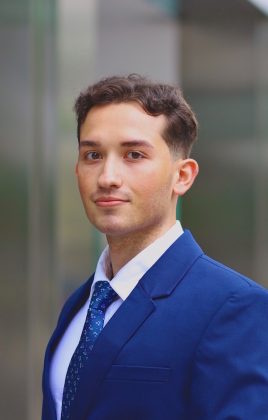
As a recent transfer student from Connecticut State Community College, Lucas Ruiz ’23 pursued his interest in history through courses with professors Alexis Dudden and Frank Costigliola – a decision that set him on a path that would eventually lead to publishing in the Bulletin of the Atomic Scientists, becoming the first-ever Fellow with the Oppenheimer Project, and convening meetings of world experts on nuclear weapons policy.
Now, as an Oppenheimer fellow, Ruiz analyzes the complex and often volatile relationship between China, Russia, and the U.S. by examining the leadership of each state.
“I think that the personalities and the individuals that lead these states are of paramount importance,” Ruiz says. “I have found that no two people have the exact same perception of the world. When thinking about how the United States can engage Russia, you have to think about how can the president of the United States engage the president of Russia?”
Of the many History majors who were graduated on May 8, twenty-two History majors graduated either as Honors Scholars or with Latin honors – some with both.
Five Honors Scholars shared their thesis abstracts with the department: one evaluates the impact of President Kennedy’s Alliance for Progress on US foreign policy toward Chile; another examines the reversal of fortune for the English monarchy in the 13th century; and another investigates a possible connection between queer/queercore zines of the 1980s-2000s and radical queer politics. Another thesis analyzes the Kurdish nationalist movement in the 20th century, while another scrutinizes the impact of the Enrollment Act of 1863, the first national draft in United States history.
Harrison Fregeau
Abstract: Facing the threat of communism spreading throughout Latin America after the 1959 Cuban Revolution, President Kennedy enacted a sweeping re-imagination of US regional foreign aid: The Alliance for Progress. Designed to thwart the spread of communism through improving continent-wide economic and social development, it represented a peak in US ambitions to affect policy changes abroad. This paper combines an analysis of US foreign policy towards Latin America, with more specific foci on Chile, US-Chile bilateral relations and the Chilean housing sector. Ultimately, the paper examines the relations between the two governments, particularly during the presidency of Eduardo Frei, an ambitious, pro-US reformer. Using housing policy as a case study, the paper examines how reformist aims contributed to counterproductive results, including the first democratic election of a Marxist president in the Western hemisphere.
Joseph Fusco
Joseph Fusco
Abstract: After the reigns of Henry II and Richard I, the prestige of the English monarchy was at an unparalleled high. The kingdom owned large stretches of land in western France and after Richard’s prominent role in the Third Crusade the monarchy could scarcely be more respected. In the beginning of the 13th century the kingdom was ruled first by King John, and then by Henry III. Despite the power of their predecessors, both kings saw a massive downturn in their authority. The barons of England were constantly rebelling and they stripped much of the power away from the crown, until at one point the king was little more than a puppet with his son Edward held hostage and Magna Carta signed and sealed to preserve future limits on the King’s power. Many historians both then and now attribute this to the weaknesses of John and Henry III. However, while this was certainly a major factor, my research has uncovered an underlying theme of greed for power on behalf of the English nobility that I believe exceeds any weaknesses the monarchs had. This paper identifies how and why the English nobility stole power from the king, and to what degree the nobility were fighting for their own glory, and not the glory of their country.
Adam Kocurek
Adam Kocurek
Abstract: In an effort to further historicize queer anarchist politics in the 20th century, this thesis worked to establish a connection between the queer/queercore zines of the 1980s-2000s and radical queer politics. Zines from the Queer Zine Archive Project database were closely examined and compared in an attempt to distill the radical politics that manifested in the space of queer punk, homopunk, and queercore. Through an exploration of these artifacts, it became evident that the radical leftist politics of the early Gay Liberation movement were transformed and founded renewed invigoration in the queercore scene, wherein authors expressed their thoughts and feelings on topics ranging from capitalism, homonormatism, racism, and normative gay integrationalist and assimilationist politics aimed at normative liberal moves towards citizenship.
David Luchs
“A State Denied: Kurdish Nationalism and the Problems of Ethnic Coordination”
David Luchs
Abstract: In this paper, I examine the history of the Kurdish nationalist movement in the 20th century. I propose that Kurdish nationalist movements that have the ability to encourage Kurds to self-identify along ethnic lines will have the most success in attracting support and achieving their goals. As a result, countries like Iraq where there is no unified sense of national identity will foster stronger Kurdish national movements. On the other hand, countries like Turkey where the state can counter Kurdish identity will be able to resist the demands of even strong Kurdish movements such as the PKK, which limits its support base by identifying itself as an ideological as well as an ethnic movement. In particular, states like Iran which successfully foster non-ethnic identification are successful in dissuading Kurds from joining Kurdish nationalist movement. This research suggests that ethnic nationalist movements which have a purely ethnic appeal for support are most likely to succeed, while those that also try to assert other messages (religious, ideological, social, etc.) are less likely.
Melissa Traub
Melissa Traub
Abstract: As recruitment slowly dwindled as the Civil War dragged on, the North was forced to pass the Enrollment Act of 1863, the first national draft in United States history. For an already unstable nation, the national draft did little to heal the divides that split the country. The policies of substitution and commutation led to great resentment, eventually sparking the New York City Draft Riots of 1863. To many Union soldiers, drafted men and substitutes were “unscrupulous men” who lied, deserted, and shirked their duty to their country. Other volunteers however, urged their loved ones to escape the draft and to support the war effort from home. My thesis examines and analyzes the thoughts and attitudes of these Union soldiers, recorded in their diaries and letters, giving us great insight into the average soldier’s opinion on recruitment and the draft, a view that has often been overshadowed by the public’s.