Web cookies (also called HTTP cookies, browser cookies, or simply cookies) are small pieces of data that websites store on your device (computer, phone, etc.) through your web browser. They are used to remember information about you and your interactions with the site.
Purpose of Cookies:
Session Management:
Keeping you logged in
Remembering items in a shopping cart
Saving language or theme preferences
Personalization:
Tailoring content or ads based on your previous activity
Tracking & Analytics:
Monitoring browsing behavior for analytics or marketing purposes
Types of Cookies:
Session Cookies:
Temporary; deleted when you close your browser
Used for things like keeping you logged in during a single session
Persistent Cookies:
Stored on your device until they expire or are manually deleted
Used for remembering login credentials, settings, etc.
First-Party Cookies:
Set by the website you're visiting directly
Third-Party Cookies:
Set by other domains (usually advertisers) embedded in the website
Commonly used for tracking across multiple sites
Authentication cookies are a special type of web cookie used to identify and verify a user after they log in to a website or web application.
What They Do:
Once you log in to a site, the server creates an authentication cookie and sends it to your browser. This cookie:
Proves to the website that you're logged in
Prevents you from having to log in again on every page you visit
Can persist across sessions if you select "Remember me"
What's Inside an Authentication Cookie?
Typically, it contains:
A unique session ID (not your actual password)
Optional metadata (e.g., expiration time, security flags)
Analytics cookies are cookies used to collect data about how visitors interact with a website. Their primary purpose is to help website owners understand and improve user experience by analyzing things like:
How users navigate the site
Which pages are most/least visited
How long users stay on each page
What device, browser, or location the user is from
What They Track:
Some examples of data analytics cookies may collect:
Page views and time spent on pages
Click paths (how users move from page to page)
Bounce rate (users who leave without interacting)
User demographics (location, language, device)
Referring websites (how users arrived at the site)
Here’s how you can disable cookies in common browsers:
1. Google Chrome
Open Chrome and click the three vertical dots in the top-right corner.
Go to Settings > Privacy and security > Cookies and other site data.
Choose your preferred option:
Block all cookies (not recommended, can break most websites).
Block third-party cookies (can block ads and tracking cookies).
2. Mozilla Firefox
Open Firefox and click the three horizontal lines in the top-right corner.
Go to Settings > Privacy & Security.
Under the Enhanced Tracking Protection section, choose Strict to block most cookies or Custom to manually choose which cookies to block.
3. Safari
Open Safari and click Safari in the top-left corner of the screen.
Go to Preferences > Privacy.
Check Block all cookies to stop all cookies, or select options to block third-party cookies.
4. Microsoft Edge
Open Edge and click the three horizontal dots in the top-right corner.
Go to Settings > Privacy, search, and services > Cookies and site permissions.
Select your cookie settings from there, including blocking all cookies or blocking third-party cookies.
5. On Mobile (iOS/Android)
For Safari on iOS: Go to Settings > Safari > Privacy & Security > Block All Cookies.
For Chrome on Android: Open the app, tap the three dots, go to Settings > Privacy and security > Cookies.
Be Aware:
Disabling cookies can make your online experience more difficult. Some websites may not load properly, or you may be logged out frequently. Also, certain features may not work as expected.
Professor Sinha will give a talk on the exhibit and her work as a Reconstruction Historian on June 4th at a special preview of “The Second American Revolution”. The exhibit will be open from June 5 through January 17 and explores the Reconstruction era’s early efforts to give newly freed and free Black Americans full citizenship and rights, and the ways in which this mission was largely eroded leaving America with consequences that have followed the nation into the 21st century.
You can read more about this exhibit on the Abraham Lincoln Presidential Library and Museum website here:
The article is entitled “The Civil Rights Era is Collapsing Before Our Eyes,” By Nikole Hannah-Jones, and appeared in both the print and online versions of The New York TimesMay 22, 2026.
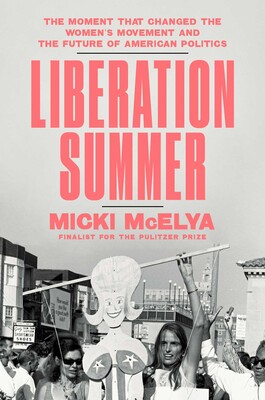
Professor McElya’s 2026 book Liberation Summer is about a key moment in the women’s liberation movement surrounding the 1968 Miss America pageant in Atlantic City and the reactions and protests it was surrounded by.
Professor McElya’s 2026 book Liberation Summer, about a key moment in the women’s liberation movement surrounding the 1968 Miss America pageant and the reactions and protests it was surrounded by, has been widely recommended by the New York Times, the Boston Globe and Kirk’s reviews. Her last book about the history of Arlington National Cemetery was a finalist for the Pulitzer.
The University of Connecticut History Department is pleased to announce that the Fall 2026 Draper Workshop will take place on November 16th, from 4:30 – 6:00 PM in Herbst Hall rm. 1o1, with a reception to follow. The event will focus on the 250th anniversary of the American Revolution, and will feature a panel discussion from professors Maya Jasanoff (Harvard University), Robert Parkinson (Binghamton University), Mark Peterson (Yale University), Karin Wulf (Brown University), and Andy Horowitz (University of Connecticut). Prof. Manisha Sinha (University of Connecticut) will moderate.
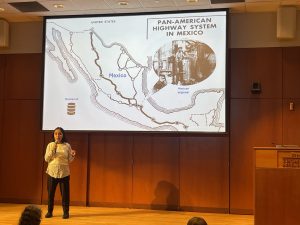
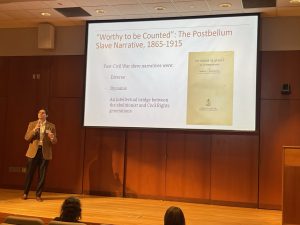
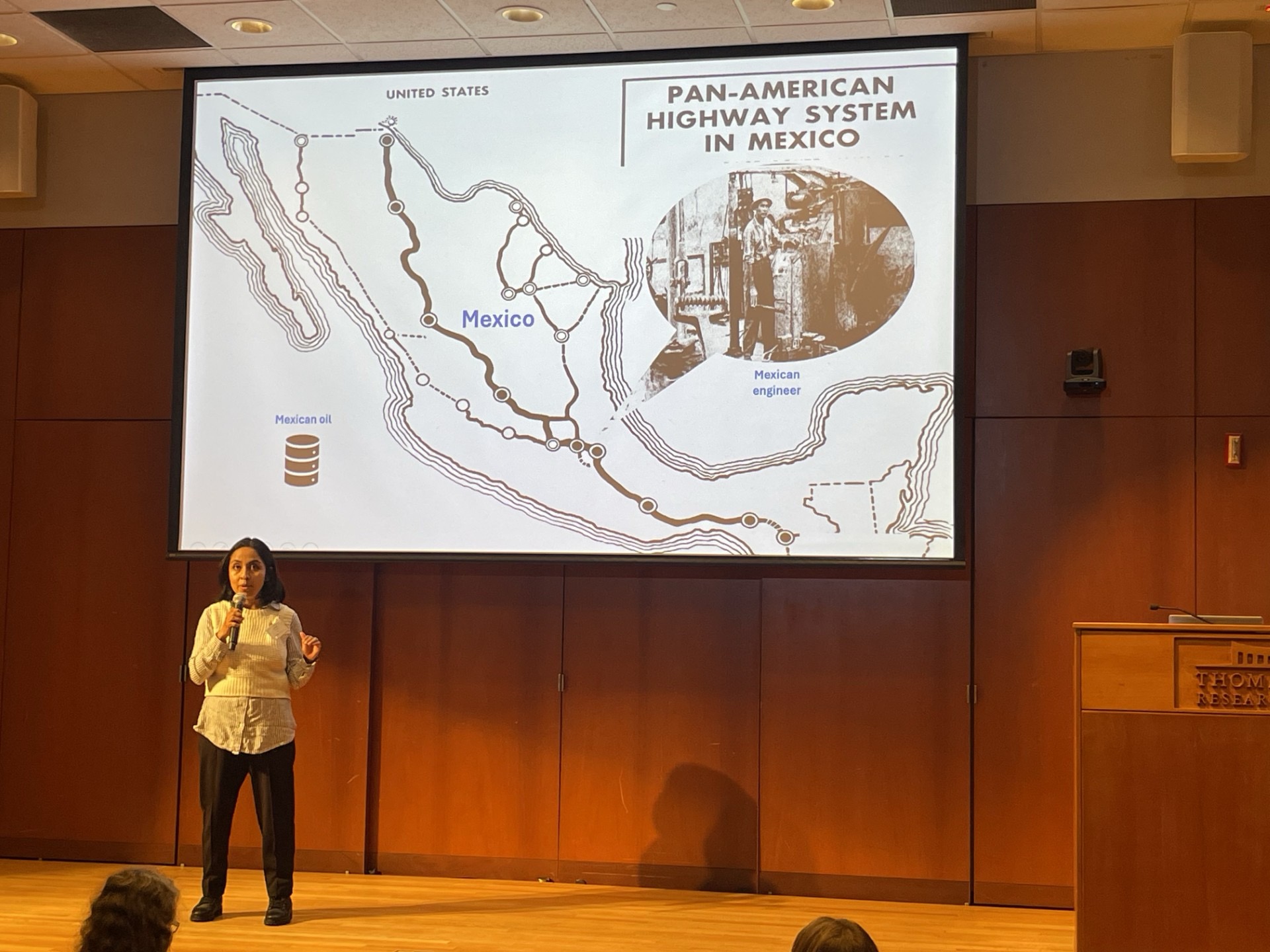
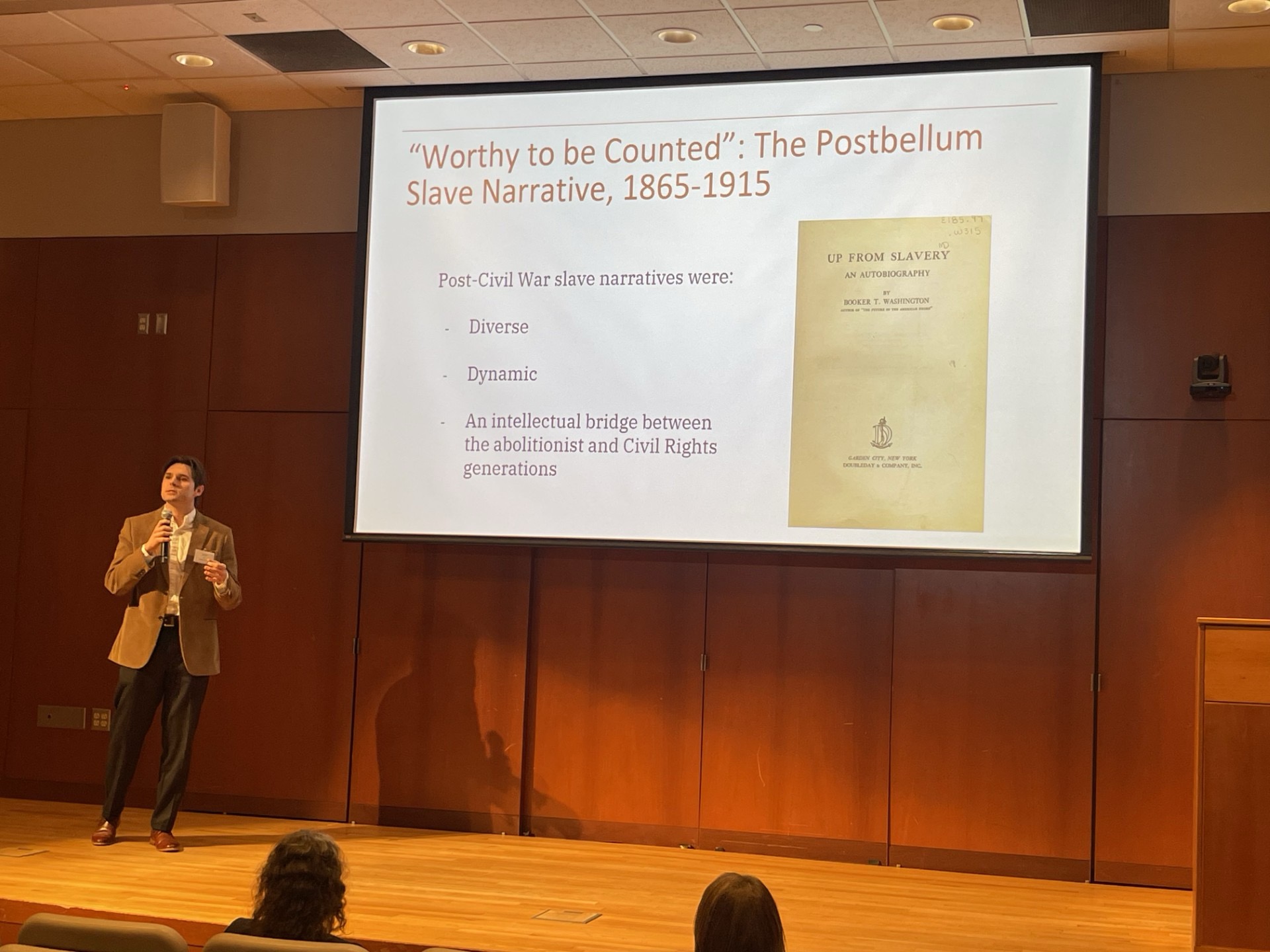
Congratulations to Lincoln Hirn and Daniela Domínguez Tavares for competing in the Three-Minute Thesis Competition this year! Both participants made it to the final round. Lincoln Hirn’s presentation was titled “Worthy to be Counted”: The Postbellum Slave Narrative, 1865-1915. Daniela Domínguez Tavares was the Runner-up in the “Arts, Humanities, and Social Science Ph.D” category with her presentation titled “Imaginaries of Mexican Infrastructure.”
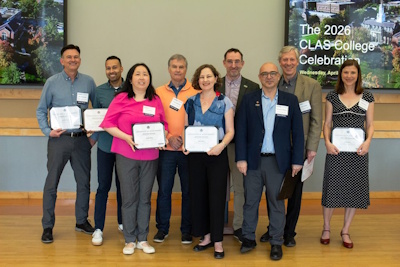
The Academic Leadership Award honors exemplary leadership by an individual who oversees a CLAS department, school, center, institute, or program. At this year’s CLAS Faculty and Staff Awards, Department Head Mark Healey was recognized for his leadership in strengthening departmental climate, transparency, and academic success.
The prize was awarded at the Organization of American Historians meeting in Philadelphia on April 17, 2026. The prize citation reads:
Following a multi-tiered selection process, the committee selected The Rise and Fall of the Second American Republic: Reconstruction, 1860–1920 by Manisha Sinha as the recipient of the SHGAPE President’s Book Prize.
Manisha Sinha’s The Rise and Fall of the Second American Republic offers a sweeping and compelling reinterpretation of Reconstruction, significantly expanding both the temporal and geographic boundaries traditionally associated with the period. Sinha provides a major new synthesis of Reconstruction scholarship—one that will stand alongside the seminal works of Eric Foner and W. E. B. Du Bois as a benchmark for a new generation of historians. The book will serve as a central text in graduate seminars on nineteenth-century U.S. history for years to come. Grounded in extensive archival research but driven by a clear and persuasive argument about the broader scope and significance of Reconstruction, it will shape how historians and their students understand this critical era. It is a powerful and important work and fully deserving of the SHGAPE President’s Book Prize.
On April 16th, Yang Zheng successfully defended her dissertation, “Gender and Transnational Education: Chinese Women Students in the United States in the Early Twentieth Century”.
Congratulations to Yang Zheng on this impressive achievement!
Participants in the four-hour retreat received a certificate upon completion of the event (contributed photo; UConn Today).
Edina Oestreicher, the executive director of UConn Hillel, said that she was invited to apply for a grant to create a “Campus Connections” initiative where student leaders gain the transferable skills of actively listening, asking meaningful questions, and practicing thoughtful communication with other leaders. With the grant, UConn Hillel partnered with the Gladstein Family Human Rights Institute to host an interactive workshop facilitated by faculty affiliated with the “Democracy and Dialogues Initiative.”
History Professor Brendan Kane, co-director of the “Democracy & Dialogues” program, started thinking about creating a new dialogue model for respectful communication back in 2016. Kane wanted to engage scholars in meaningful and dynamic ways with community members, emphasizing UConn’s mission as a public university. Simultaneously, witnessing universities trying to implement spaces for dialogue after widespread incidents of racism occurred across campuses nationwide, Kane wanted to create a unique process to build strong and resilient communities. The “Democracy and Dialogues Initiative” is part of Dodd Human Rights Impact Programs.