Deirdre Cooper-Owens in “The Cancer Detectives” on PBS

Dr. Cooper-Owens participated in the PBS documentary, The Cancer DetectiveThe documentary follows the previously untold story of the war on cervical cancer.Associate professor of history, Deidre Cooper Owens

Her research interests include the history of medicine, slavery, and women in the 19th century United States. She is currently working on a biography of Harriet Tubman that examines the revolutionary through the lens of disability and a monograph about the history of race, medical discovery, and the C-section.

Prof Ogbar’s “America’s Black Capital” Talk Broadcast Over C-Span

Jeff Ogbar, professor of history, UConnJeffrey O.G. Ogbar gave a talk on his new book, America’s Black Capital: How African Americans Remade Atlanta in the Shadow of the Confederacy at the Atlanta Center in January.

The event was then broadcast over C-Span.

America’s Black Capital chronicles how African American’s pushed back against Confederate ideology and transformed Atlanta into today’s “Black Mecca.”


Recent Department Achievements

A hearty congratulations to our faculty and graduate students on their wonderful recent awards and achievements!

Katie Angelica has accepted a position for next year as Visiting Assistant Professor of History at Purdue University – Fort Wayne.

Daniela Dominguez Tavares has won a Greenhouse Studios Graduate Fellowship for 24-25.

Yusuf Mansoor has won a UCHI Draper Dissertation Fellowship for 24-25.

David Evans has had an article drawing from his long-ago 5102 paper, which later become a key part of his dissertation, accepted by the prestigious journal Cold War History.

Peter Zarrow and Hana Maruyama have received UCHI Faculty Fellowships for 24-25; Peter Lavelle has won a National Endowment for the Humanities Fellowship.

Helen Rozwadowski received the John Gardner Award from the Mystic Seaport.

Manisha Sinha on American Democracy April 4th

Prof. Manisha Sinha will take part in a panel titled “The Past, Present, and Future of American Democracy,” on Thursday, April 4th at the Thompson Room, Barker Center at Harvard University from 4:15 p.m. to 6:15 p.m. Manisha Sinha, professor of history

The event will be moderated by Lisa McGirr (Warren Center Director). The panelists are: Carol Anderson (Emory), Daniel Ziblatt (Harvard), Gary Gerstle (Cambridge University), Manisha Sinha (Univ. of Connecticut). There is no paper or supplemental reading for this event.

This is co-sponsored by the Warren Center, American Studies, Department of History, Hutchins Center for African & African American Research, and the Center For American Political Studies.

What is a Disaster?: Andy Horowitz and Jacob A. C. Remes

On Thursday, April 4th at 6 p.m. Connecticut State Historian and UConn History Professor Andy Horowitz will be in conversation with Jacob A. C. Remes at the Connecticut Museum of Culture and History titled “What is a Disaster?”

Andy Horowitz, associate professor of History and Connecticut State Historian

From the event site:

Floods and earthquakes, wars and famines, engineering failures and economic collapses — these frightening events seem to define modern life. We name them “disasters.” But what makes a disaster different from other periods of time? In a freewheeling conversation, two leading scholars in the field of disaster studies will consider events in Connecticut history and beyond, thinking out loud together about why some kinds of bad news are considered disasters while others are not, and what difference it makes.”

Find more information here.

Historians Mahoney and Horrocks on American Girl Dolls

History Ph.D.’s Mary Mahoney ’18 and Allison Horrocks ’16 explore American Girl dolls through Allison Horrocks, 2016 History Ph.Dlenses of history and pop culture in their podcast “The Dolls of Our Lives,” and their recent book, The Dolls of Our Lives: Why We Can’t Quit American Girl.

Their work has garnered significant attention and interest.  It has been featured in UConn Today, “In New BooMary Margaret Mahoney, History Department, UConnk, History Ph.D.s Explore ‘Why We Can’t Quit American Girl,’” where they discuss their podcast, their book, and weigh-in on which American Girl’s they think would earn history Ph.D.’s.

Phil Goduti Dissertation Defense, “The Durability of a Kennedy”

On February 7. 2024 Phil Goduti successfully defended his dissertation, “’The Durability of a Kennedy’: How Emotional Communities Contributed to John F. Kennedy’s Core Beliefs, 1930-1963″ which examines how emotions shaped decision-making of U.S. foreign policy.

From the abstract:

“This dissertation examines the evolution of John F. Kennedy’s core beliefs as he inhabited four emotional communities throughout his life and analyzes whether those beliefs played a role in shaping foreign policy when he served in public office. Barbara Rosenwein posits the notion of emotional communities in her examination of the Middle Ages.


Those communities consisted of his family, education (boarding school and Harvard), military service (the Navy in WWII), and time in public office (from Congress to the presidency). The study analyzes the experiences and relationships within those communities and how they contributed to an evolution of his core beliefs such as masculine toughness, loyalty, sacrifice, and duty to one’s nation. The dissertation also considers how pain and suffering may have played a role in shaping John F. Kennedy’s core beliefs through an examination of the many illnesses that he endured throughout his lifetime.

This dissertation consists of three parts that examine three distinct phases in his life and how these emotional communities were present within those each phase. Part One examines his family history and his education at boarding school and Harvard. The two emotional communities examined within this part are the foundation for his core beliefs that followed him through life. However, his time in war, which is examined in Part Two, led to a re-examination of those beliefs and had an impact on him for the rest of his life. In addition, the death of his brother, Joseph Kennedy, Jr., left an indelible mark that never faded. This dissertation contends that these years were the most important in his short life. The study ends with an examination of his experiences and relationships while in public office, the final emotional community. Each of the three chapters in Part Three focus on his time in the House of Representatives, Senate, and the presidency.”


A hearty congratulations to Phil and his family on this remarkable achievement and important historical contribution!

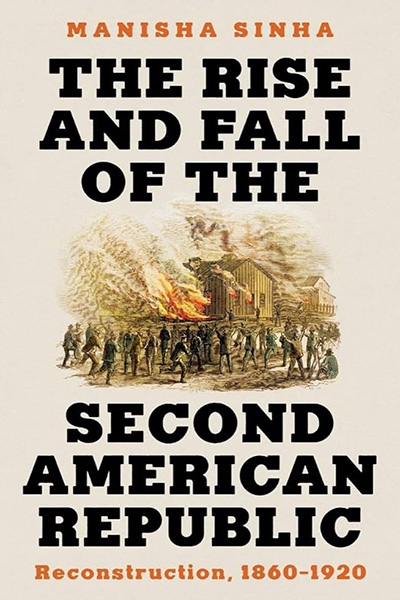
The Rise and Fall of the Second American Republic

Manisha Sinha, Author

Norton, 2024

Description

We are told that the present moment bears a strong resemblance to Reconstruction, the era after the Civil War when the victorious North attempted to create an interracial democracy in the unrepentant South. That effort failed—and that failure serves as a warning today about violent backlash to the mere idea of black equality.

In The Rise and Fall of the Second American Republic, acclaimed historian Manisha Sinha expands our view beyond the accepted temporal and spatial bounds of Reconstruction, which is customarily said to have begun in 1865 with the end of the war, and to have come to a close when the "corrupt bargain" of 1877 put Rutherford B. Hayes in the White House in exchange for the fall of the last southern Reconstruction state governments. Sinha’s startlingly original account opens in 1860 with the election of Abraham Lincoln that triggered the secession of the Deep South states, and take us all the way to 1920 and the ratification of the Nineteenth Amendment, which granted women the right to vote—and which Sinha calls the "last Reconstruction amendment."

Within this grand frame, Sinha narrates the rise and fall of what she calls the "Second American Republic." The Reconstruction of the South, a process driven by the alliance between the formerly enslaved at the grassroots and Radical Republicans in Congress, is central to her story, but only part of it. As she demonstrates, the US Army’s conquest of Indigenous nations in the West, labor conflict in the North, Chinese exclusion, women’s suffrage, and the establishment of an overseas American empire were all part of the same struggle between the forces of democracy and those of reaction. The main concern of Reconstruction was the plight of the formerly enslaved, but its fall affected other groups as well: women, workers, immigrants, and Native Americans. From the election of black legislators across the South in the late 1860s to the Great Railroad Strike of 1877 to the colonial war in the Philippines in the 1890s, Sinha narrates the major episodes of the era and introduces us to key individuals, famous and otherwise, who helped remake American democracy, or whose actions spelled its doom.

A sweeping narrative that remakes our understanding of perhaps the most consequential period in American history, The Rise and Fall of the Second American Republic shows how the great contest of that age is also the great contest of our age—and serves as a necessary reminder of how young and fragile our democracy truly is.

The Rise and Fall of the Second American Republic book cover

Prof. Sinha Signs Brief in Colorado Ballot Case

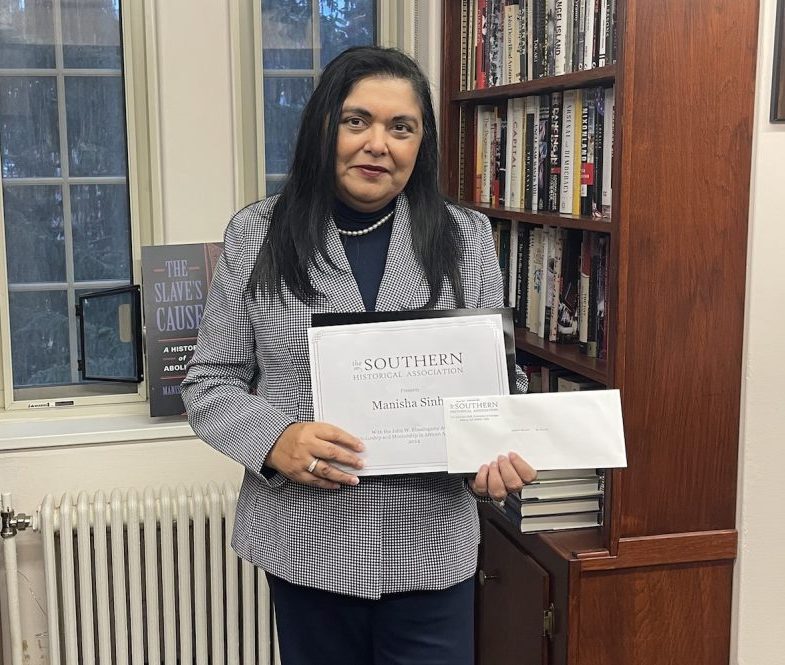
Manisha Sinha, professor of history

Prof. Manisha Sinha is one of twenty-five Civil War and Reconstruction historians who signed an amicus brief in support of Colorado’s attempt to remove Donald Trump from the ballot under the 14th Amendment, which bars insurrection participants from running for office. A summary of the brief’s main arguments is featured in the Guardian article, “US historians sign brief to support Colorado’s removal of Trump from ballot.”

Find the whole brief here.

A second brief from historians regarding the case cites Prof. Sinha’s upcoming book, The Rise and Fall of the Second American, 1860-1920